Trading Places
A family swaps brownstone living for a Cape Cod-inspired home in Kenilworth.
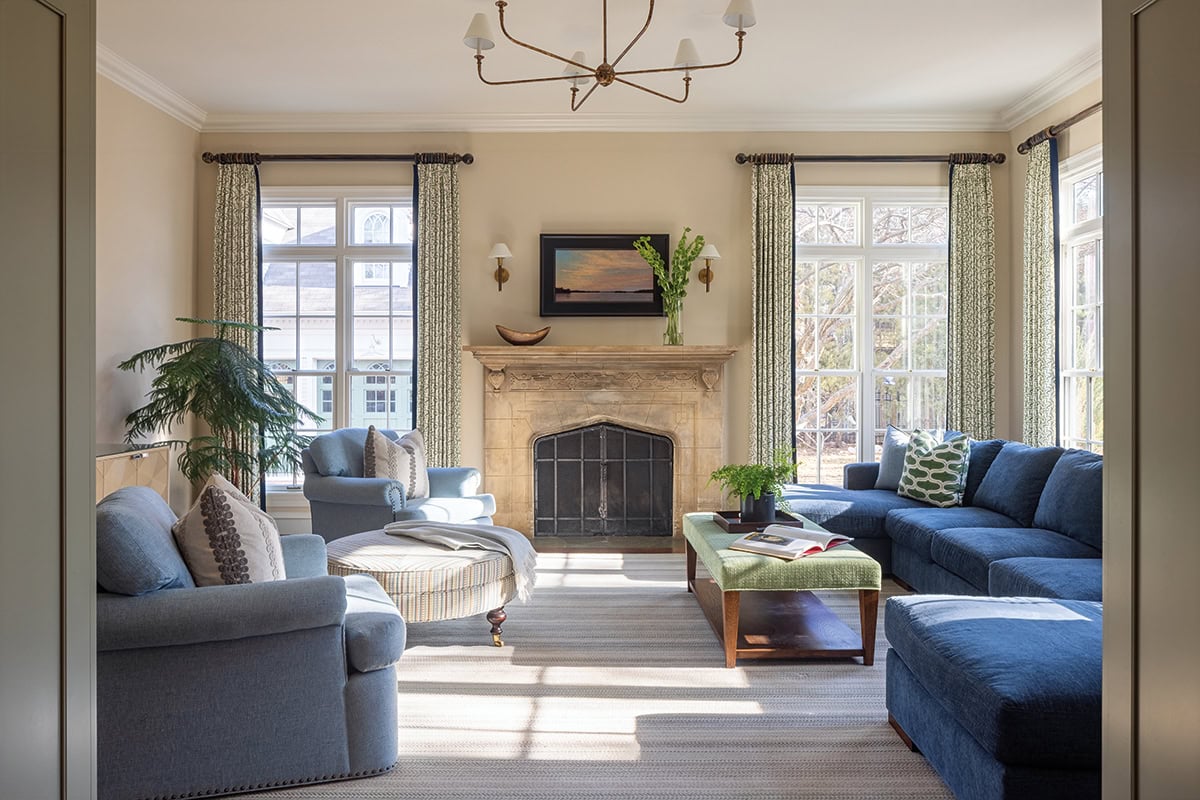
Sumptuous Kravet furniture pieces upholstered in Stroheim fabric anchor the living room, framed by Cowtan & Tout drapery panels, Visual Comfort sconces, and a Port Eliot cocktail table, with pillows detailed in Samuel & Sons trim.
Some renovations start with a wish list. This one began with a Wild West kitchen that felt entirely out of place—the legacy of a previous owner who’d decorated it like a Yellowstone sound-stage. That was the first challenge facing designer John Cialone of Tom Stringer Design Partners when a longtime client family traded their city brownstone for a white-columned, federal-leaning house in Kenilworth, walking distance to the train and, from the curb, a dead ringer for an ambitious Cape Cod cottage. Inside, the Montana fantasy had none of the ease this young family of five was after—and Cialone already had a good sense of what that ease would look like for them.
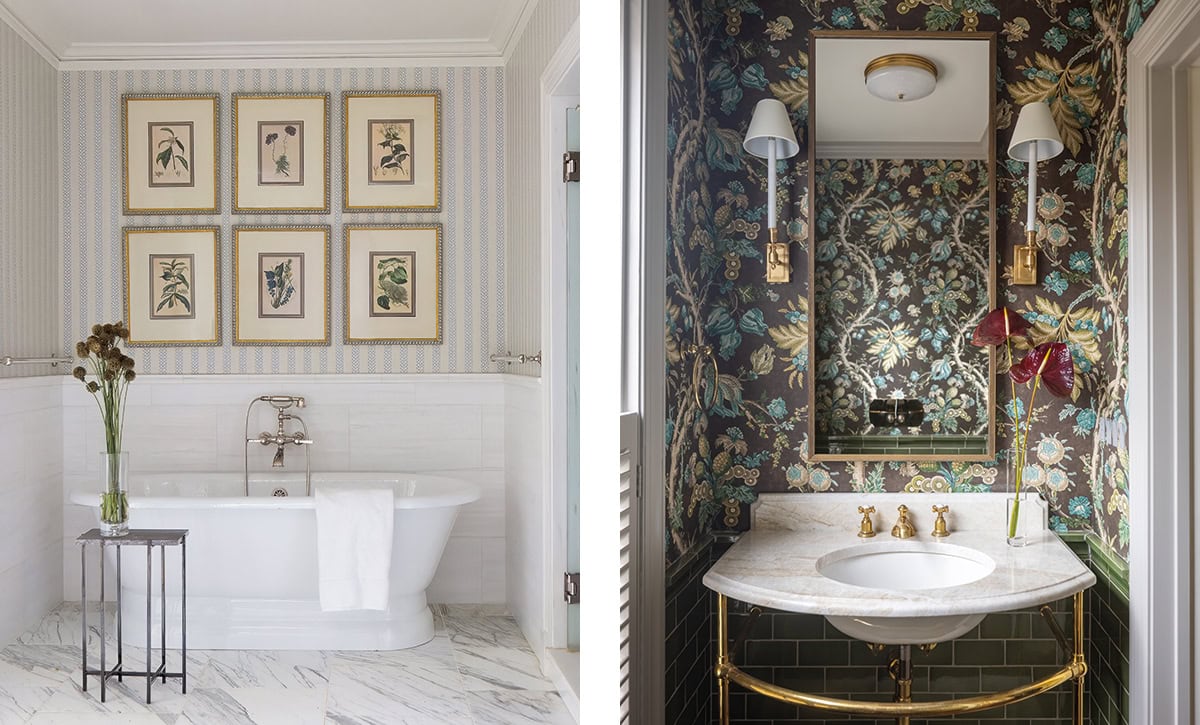
Left: A Cheviot cast-iron tub with its original nickel filler sits on Old World Calacatta marble beneath a gallery of botanical prints.
Right: Thibaut’s Chatelain wallcovering wraps the powder room in inky florals, while Visual Comfort sconces and ceiling fixture cast flattering light over the bow-front, marble-topped vanity. Through CAI Designs.
This was his third project for the couple. He’d designed their city apartment first, then a lake house north of town, so by the time this house came along, he knew how they lived. The three children are all budding gourmands, revering Chicago’s tasting-menu scene the way other kids talk baseball stats. “I feel like I know what they want before they say it,” Cialone says. It shows.
The kitchen got the most drastic treatment: a near-total gut, with the old window—barely a window at all—blown wide open, so a corner that used to sit in shadow now gets afternoon light all day. That new light is part of what let the kitchen’s two shades of sage read true instead of gray, a distinction Cialone worried about enough that he split the cabinets and island a shade apart, just for contrast. The mismatch continues overhead: Visual Comfort fixtures next to Urban Electric ones over the island, nickel paired with bronze—the kind of small friction that keeps a room from feeling too matched-up.
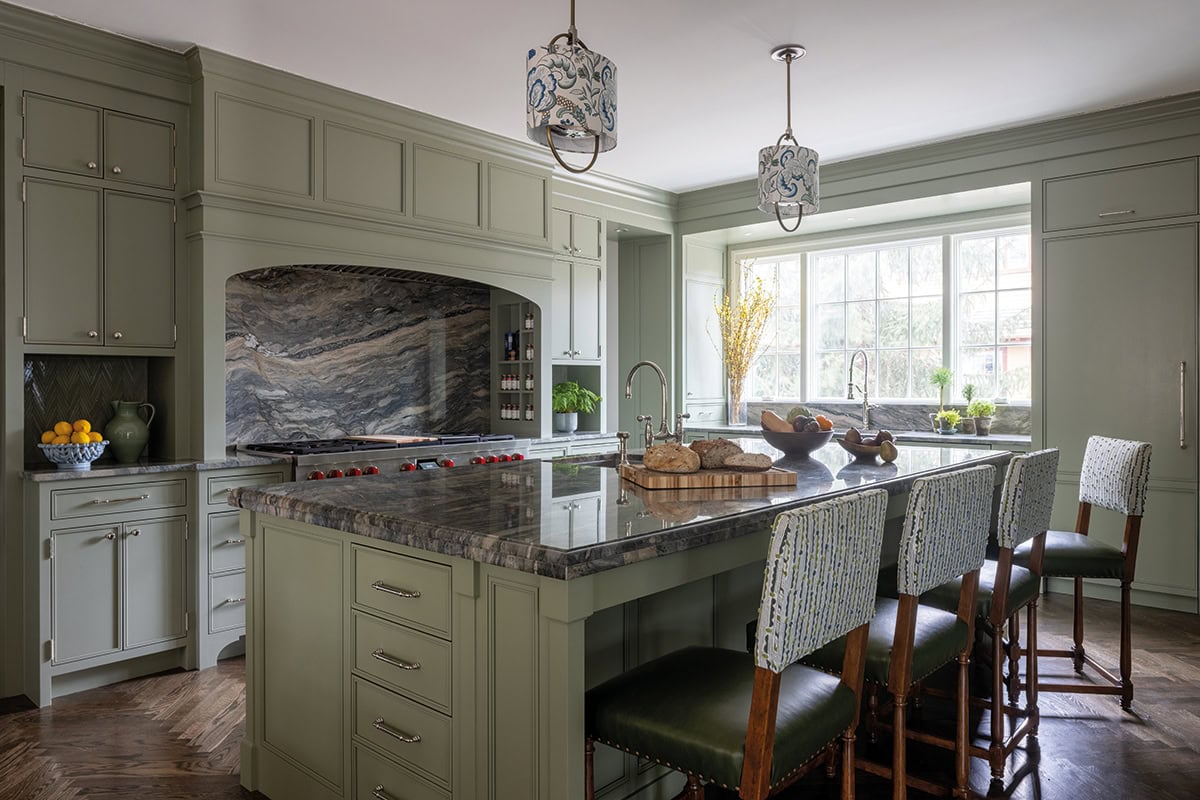
In the kitchen, a newly enlarged window floods the sink area with natural light, creating a second work zone beyond the expansive island. The backsplash and countertop were fashioned from Le Jardin quartzite. Range by Wolf. Faucets by Brizo.
The family room runs on the same instinct—restraint with a little mischief built in—but through color the family already trusted. Blue and green weren’t new for them; Cialone had used the same pairing on their lake house years earlier, and it had earned its keep since. Here it shows up in a bolder floral wallpaper, one that needed brown worked in, or it risked looking, as he put it, “overly preppy.”
That same logic carries into the living room, where a card table doubles as a party buffet—proof of Cialone’s real preoccupation: rooms that actually get used, not photographed once and shut off.
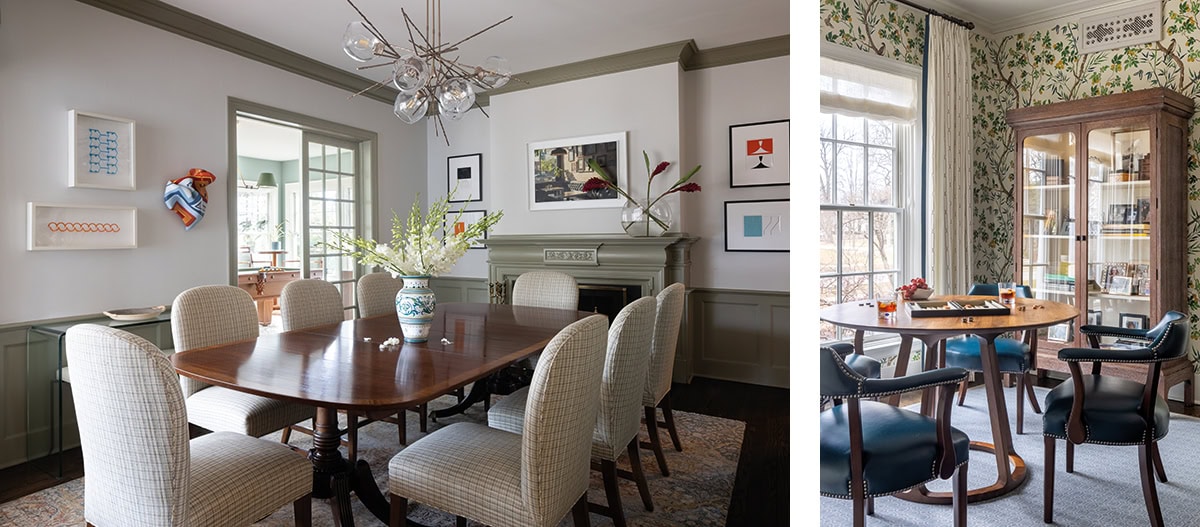
Left: The dining room, sheathed in creamy white and trimmed in sage green, displays part of the family’s growing art collection. The sculptural brass-and-glass overhead fixture lends a modernist note to the traditional furniture silhouettes.
Right: Marine-blue Hancock & Moore leather chairs ring a game table in the living room’s window corner, where chinoiserie wallcovering and a glass-front cabinet add collected, clubby depth.
The wife, a former Sotheby’s specialist, brought a genuine collector’s eye to the art on the walls, and that same instinct—valuing what’s already good rather than starting over—shows up again in the furnishings, most of which lean toward reuse over replacement wherever the house reasonably allows it.
“They’re just terrific clients, over and over,” Cialone says. It’s the kind of thing a designer only gets to say the third time around.